
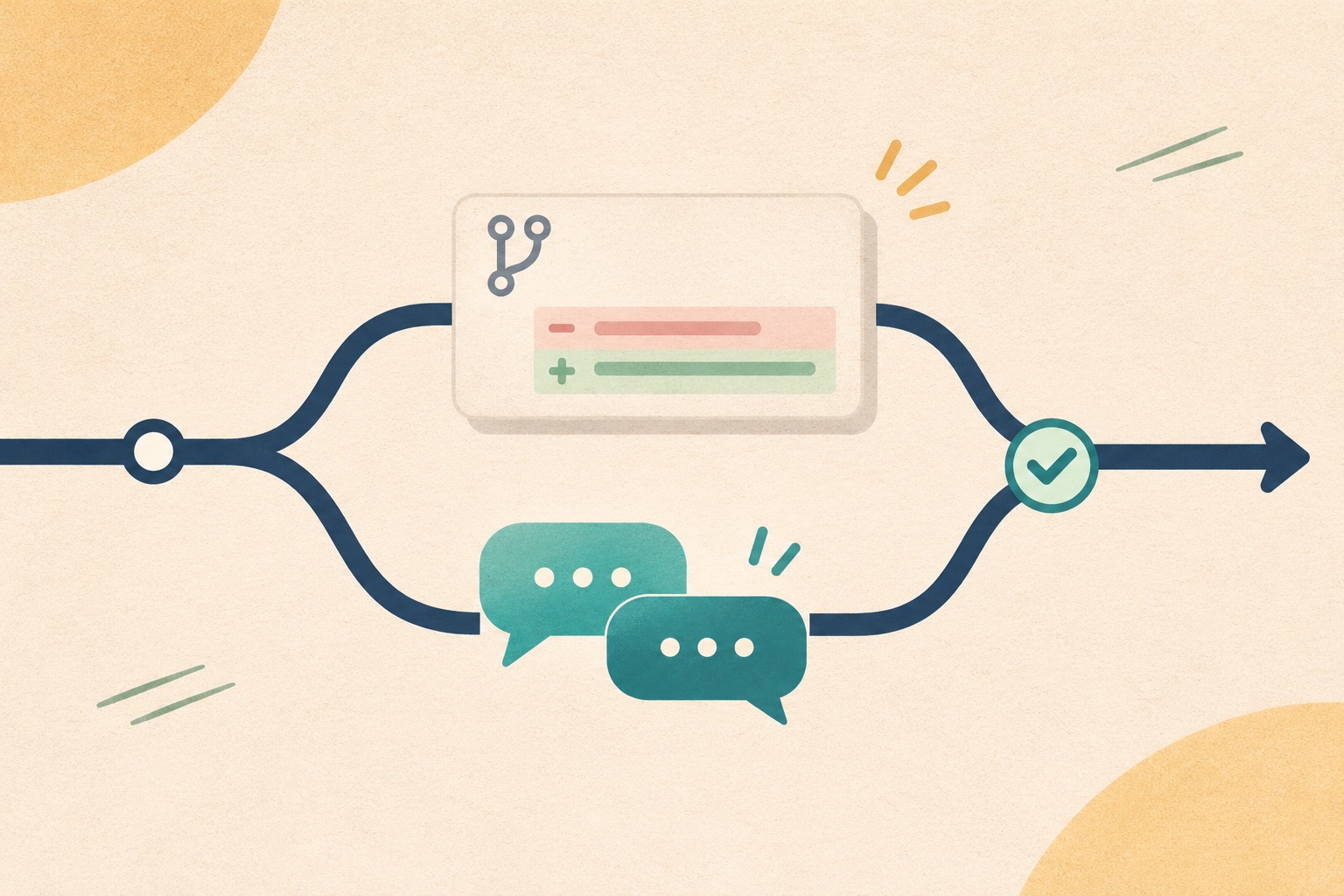
Suppose I ask a coding agent to explain a change, spot a problem in the explanation, and ask it to revise the code. By the time I open a pull request, I’ve already done some review.
This is the part that caught my attention in Christoph Treude and Sebastian Baltes’s preprint What Will Replace Pull Requests? Rethinking Software Collaboration for AI Agents. They reviewed 50 documents from 31 organizations or individuals, including maintainer policies, vendor announcements, and practitioner essays. They looked at five things we use pull requests for. We integrate changes, review them, record why we made them, establish who is responsible, and give people without write access a way to contribute.
Of the 44 documents that took a position, 32 kept the pull request in some form, including 12 that would restrict who could submit one. Only Zed reported using a replacement in practice, on the repository for its own Delta tool. In Delta, a reviewer can ask an agent to explain or revise a change in a thread tied to the code. That gives the team a place to review the change and keep the rationale. There’s still the question of how someone outside the team gets a change considered. Two documents proposed a way for outsiders to contribute without pull requests, and neither reported anyone using it.
For me, the interesting question is what happens to our metrics. We often use comments and approvals to tell whether a change was reviewed. If the discussion moves into a session, a change can look unreviewed in the data. And if a project stops using pull requests altogether, its new changes disappear from a dataset built from pull requests. A dashboard can make both changes in the workflow surprisingly easy to miss.
The paper maps what people are trying. The documents it reviewed offered no measurements of whether these alternatives improve code review. I’d like to see whether giving reviewers a short rationale helps them find defects that they would miss with just the diff. I’d also want to know what happens to first-time contributors when a project changes the way it accepts patches. Those two questions could have very different answers, even for the same project.
