There is a lot of interest in Agentic AI and coding assistants, lots of hype, and lots of scare. This paper does a large-scale experiment on how much coding assistants really help. They look at 150 developers, and they find that AI helps in short-term productivity without any impact on maintainability.
In this video, they explain a lot of cool things and demystify the use of AI. They find that knowing what you want to do helps a lot when using AI agents – so, again, good programmers will be fantastic, while bad programmers will not have a chance.
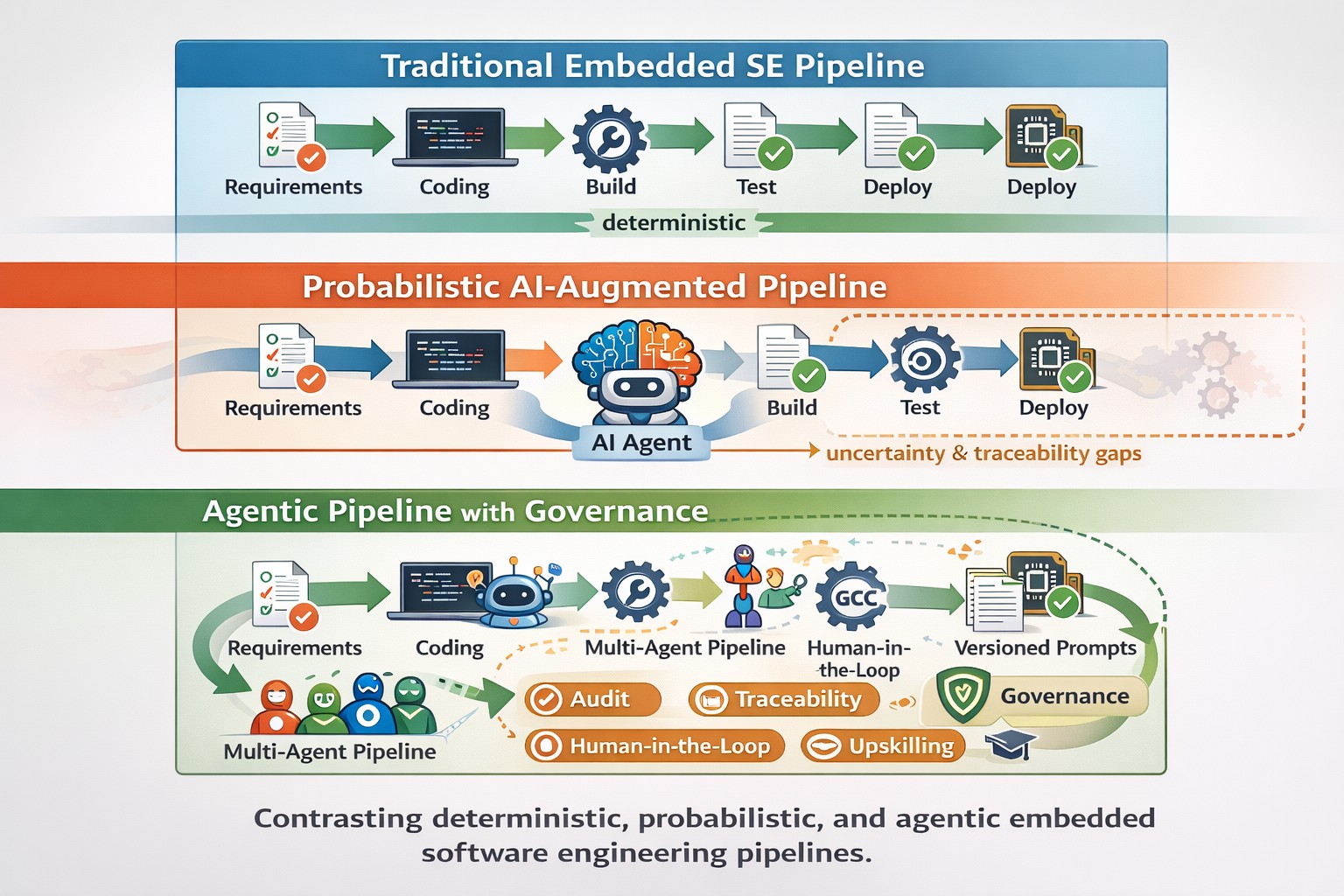
We’re witnessing a transformative shift in embedded software engineering as generative AI moves from a tool to an active participant in development pipelines. In our recent study, we explored how embedded software teams—especially in safety-critical and resource-constrained domains—are adapting to this change. Unlike conventional programming, embedded systems demand determinism, reliability, and traceability, attributes that stochastic, AI-generated artifacts can undermine.
Through qualitative interviews and structured brainstorming with senior engineers across four companies, we identified eleven emerging practices and fourteen challenges shaping generative AI adoption. Central to these practices is the concept of agentic pipelines—multi-agent continuous integration and delivery flows where generative agents collaborate across coding, compiling, testing, and validation. Key practices include designing AI-friendly artifacts, integrating compiler-in-the-loop feedback, and managing prompt repositories for auditability and consistency.
Equally important are governance and sustainability concerns. Teams emphasize human-in-the-loop supervision, formal governance frameworks, traceability of models and outputs, and workforce upskilling to responsibly harness AI automation. Our findings reveal that while generative AI offers substantial productivity gains, sustainable adoption in embedded systems hinges on balancing autonomy with accountability—without compromising safety or certification requirements.