
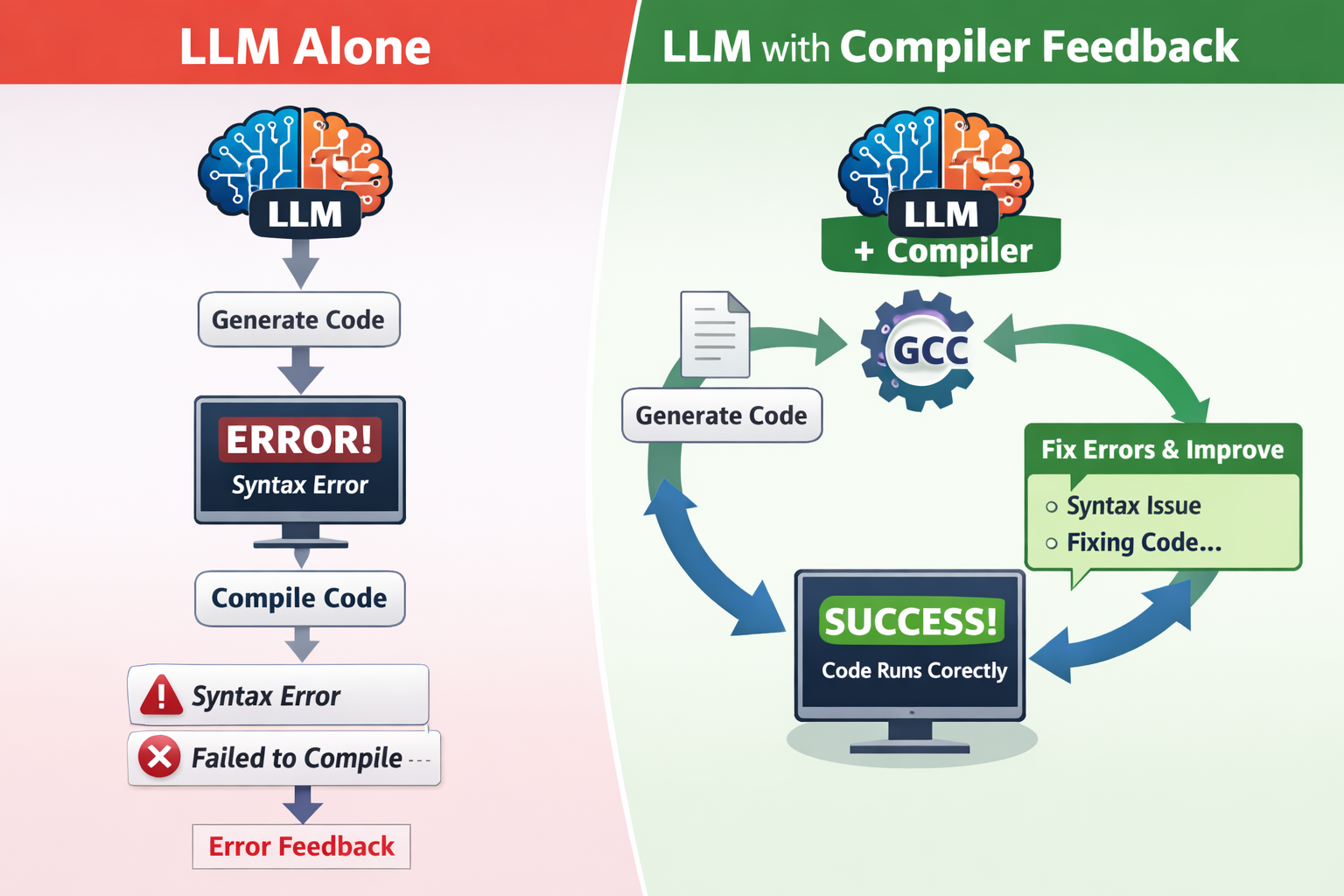
What happens if you give a compiler to an LLM…

https://www.arxiv.org/abs/2601.12146

Large Language Models (LLMs) are now central to code generation, but they often produce non-compiling or incorrect programs. We investigate how giving an LLM direct access to a real compiler (gcc) transforms it from a passive code writer into an active programming agent.

We conduct an extensive experiment on 699 real programming tasks in C, using models from 135 M to 70 B parameters. With compiler feedback integrated into the generation loop, the LLMs dramatically improve: compilation success jumps by 5.3 – 79.4 percentage points, syntax errors drop ~75 %, and undefined references drop ~87 %.

Interestingly, smaller LLMs with compiler feedback can outperform larger models without this access, suggesting that tools like compilers can compensate for model size and reduce energy/compute costs in software applications.

Overall, the study highlights the role software engineering tools play in practical LLM deployment, pushing us toward more interactive, feedback-driven code agents rather than one-shot generators. It’s a promising step toward combining NLP models with existing development ecosystems for better accuracy and efficiency.
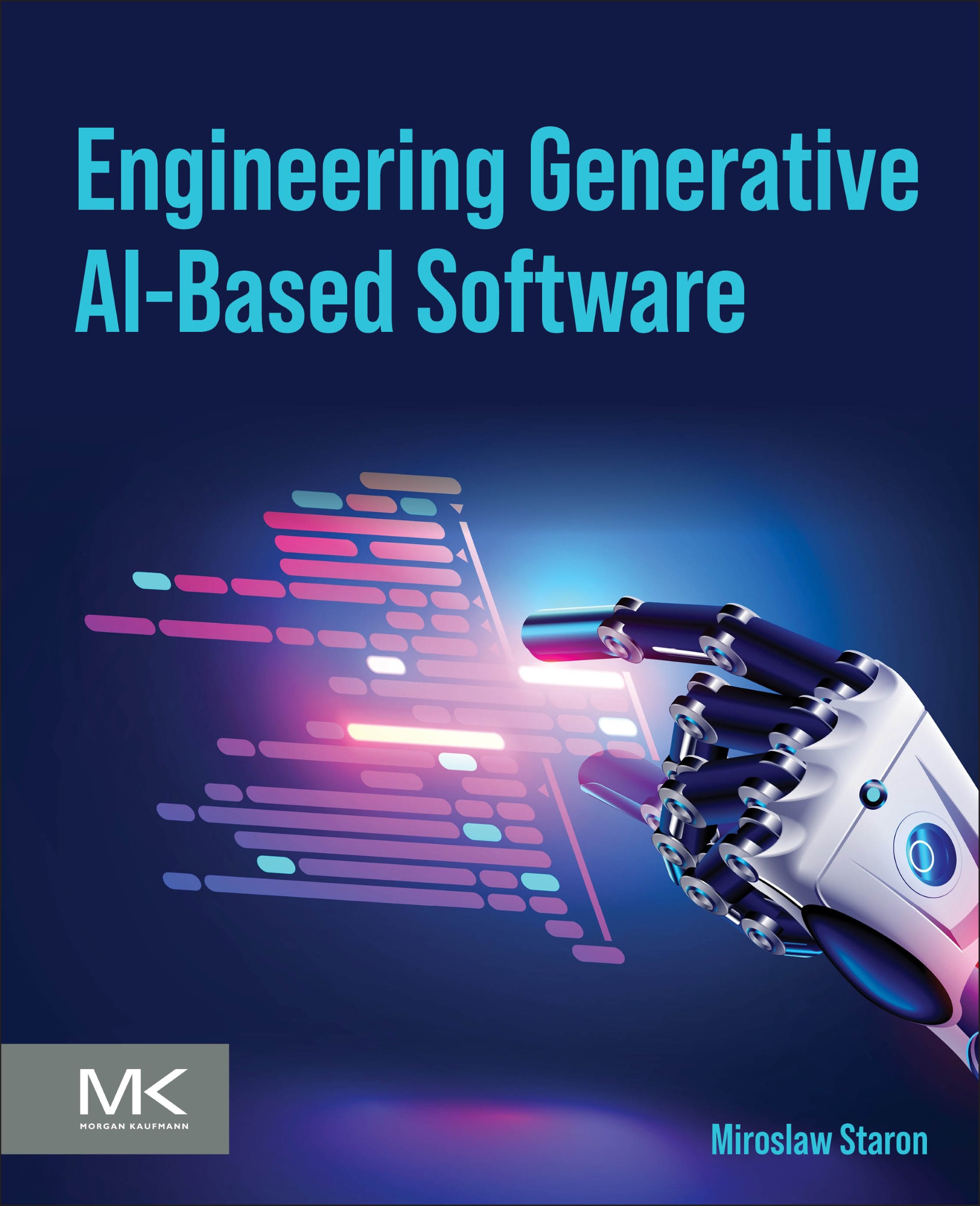
New year, new book!

Link to amazon

During the entire 2025, I’ve had a chance to get into details with programming of agents, LLMs, and what have you. Thanks to the fact that my role as pro-dean ended, I’ve been given a lot of time to do it.

My family has supported me a lot too. Without them, this would not be possible.

So, why did I even think about writing another book, one may wonder. Well, I’ve been asked by many students and colleagues on how to design good AI software. You, something that is beyond just hacking two lines of code together.

I’ve also organized several Hackathons where we learned how to create multi-agent systems and how to work with them. So, I decided it is time to document all my experiences and go deep on the software design. This book is the result of that. This is what the back cover says:

Engineering Generative-AI Based Software discusses both the process of developing this kind of AI-based software and its architectures, combining theory with practice. Sections review the most relevant models and technologies, detail software engineering practices for such systems, e.g., eliciting functional and non-functional requirements specific to generative AI, explore various architectural styles and tactics for such systems, including different programming platforms, and show how to create robust licensing models. Finally, readers learn how to manage data, both during training and when generating new data, and how to use generated data and user feedback to constantly evolve generative AI-based software. As generative AI software is gaining popularity thanks to such models as GPT-4 or Llama, this is a welcomed resource on the topics explored. With these systems becoming increasingly important, Software Engineering Professionals will need to know how to overcome challenges in incorporating GAI into the products and programs they develop.

Here is the link to the book repo: https://github.com/miroslawstaron/engineering_generative_ai_systems

If you want to play around with our agentic framework, here it is online too!

https://github.com/miroslawstaron/agenticAI